Dr Halliday Sutherland’s religious journey
Dr Sutherland’s religious journey was outlined in Exterminating Poverty:
Born in 1882, he had been “brought up a Scots Presbyterian” but was by 1904 “in theory an agnostic and in practice an atheist”. On the outbreak of World War I, he joined the Church of Scotland: “In August 1914 there came the hazards of war, and for me the time had come when it was expedient to make my peace with God. At a few hours’ notice the Church of Scotland admitted me to her membership.” It was not until 1919, that he was accepted into the Catholic Church at the Church of the Immaculate Conception in Farm Street, London.
Exterminating Poverty: The true story of the eugenic plan to get rid of the poor, and the Scottish doctor who fought against it by Mark H. Sutherland (with Neil Sutherland).
The timeline below shows that Dr Sutherland began to oppose eugenics long before he became a Catholic.
| Year | Opposition to eugenics | Religious status |
| 1882 | Dr Sutherland born and “brought up a Scots Presbyterian.” | |
| 1904 | Dr Sutherland was “in theory an agnostic and in practice an atheist” | |
| 1912 | The Soil and the Seed in Tuberculosis. Article in the British Medical Journal that argued that TB was primarily an infectious, rather than an inherited, disease. | |
| 1914 | “In August 1914 there came the hazards of war, and for me the time had come when it was expedient to make my peace with God. At a few hours’ notice the Church of Scotland admitted me to her membership.” | |
| 1917 | Consumption: Its Cause and Cure. Dr Sutherland’s speech that identified eugenicists as a significant obstacle to the cure and eradication of tuberculosis. | |
| 1919 | Dr Sutherland accepted into the Catholic Church at the Church of the Immaculate Conception in Farm Street, London. | |
| 1921 | [Dr Stopes and Mr Roe open the Mothers’ Clinic in Holloway, London.] | |
| 1922 | Birth Control: a statement of Christian doctrine against the Neo-Malthusians. Dr Sutherland’s 1922 book that led to a writ for defamation (libel). |
The question is, then:
Why did Dr Sutherland oppose eugenics?
In 1910, Dr Sutherland became the medical officer for the St Marylebone Dispensary for the Prevention of Consumption. At that time, around 50,000 Britons died each year from Consumption, 20,000 from other forms of tuberculosis and 150,000 were disabled. It was three times more likely to affect the poor than the better-off and when the breadwinner became ill, whole families became destitute. It was the cause of around 10% of pauperism in Britain.
Sutherland did not like eugenics because (like Malthusianism) it not only blamed the poor for their poverty, but also for their ill-health as well (eugenicists saw TB as an inherited condition caused by the sufferer’s inferior heredity). He argued that “we find ample physical resources sufficient to support the entire population, and we also find evidence of human injustice, incapacity, and corruption sufficient to account for the poverty and misery.”
To speak out publicly against eugenics at that time was to swim against the tide of a “science” supported by the intelligentsia and the Establishment.
As Ann Farmer wrote in her 2008 book By Their Fruits: Eugenics, Population Control, and the Abortion Campaign, Dr Sutherland did not oppose eugenics and reproductive control because of the Catholic Church; he was drawn to the Catholic Church because of its consistent opposition to eugenics and reproductive control.
Why this matters.
This timeline reveals that Dr Sutherland was an active opponent of class-based coercive eugenics in Britain long before he became a Catholic, and that this arose because of his work to prevent and cure tuberculosis. It matters therefore, because:
- Attributing Dr Sutherland’s opposition to Stopes to his religion does not explain his motivation adequately;
- The relationship between tuberculosis and eugenics and contraception are important parts of birth control and contraception in Britain.
Despite this, none of the biographies of Marie Stopes have included this important aspect of the Stopes v Sutherland dispute:
- Maude, A. (1924). The Authorized Life of Marie C. Stopes.
- Maude, A. (1933). Marie Stopes: Her Work and Play.
- Hall, R. (1977). Passionate Crusader: The Life of Marie Stopes.
- Rose, J. (1992). Marie Stopes and the Sexual Revolution.
- Debenham, C. (2018). Marie Stopes’ Sexual Revolution and the Birth Control Movement.
For them, Dr Sutherland’s opposition to Stopes (1) began in 1919 when he became a Roman Catholic and (2) it arose because Catholic dogma forbids the use of contraceptive devices.
Why it is unlikely to change anytime soon
Sources such as the B.B.C. and Encyclopedia Brittanica (perhaps relying on Stopes biographers) misinform their readers and spread disinformation. This is highly regrettable given that these sites are seen as authoritative by search engines and by AI.
Both the B.B.C. over-emphasise the “Catholics Against Contraceptives” schema and understate Catholic (and Sutherland’s) opposition to British class-based coercive eugenics.
On the Britannica website, the first paragraph highlight religious opposition to Stopes:
Marie Stopes … was an advocate of birth control who, in 1921, founded the United Kingdom’s first instructional clinic for contraception. Although her clinical work, writings, and speeches evoked violent opposition, especially from Roman Catholics, she greatly influenced the Church of England’s gradual relaxation (from 1930) of its stand against birth control.
https://www.britannica.com/biography/Marie-Stopes
It is only at the end of a lengthy second paragraph that her advocacy for eugenics is mentioned:
However, Stopes also was a staunch supporter of eugenics, and she advocated for eugenic birth control, wherein inferior women of the lower classes would be prevented from having children.
https://www.britannica.com/biography/Marie-Stopes
Stopes staunch support of eugenics was not a “however … also”. Her stauch support of eugenics led to her birth control campaign. A picture of the cervical caps dispensed by Stopes dispels any separation of her advocacy for contraception and her eugenic beliefs:
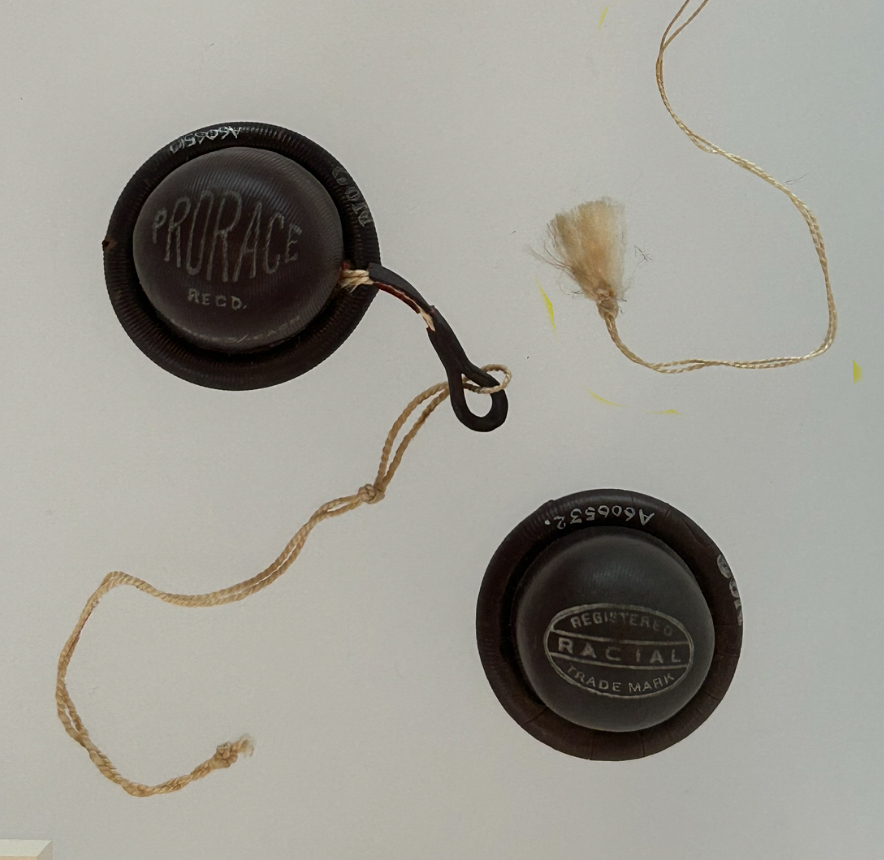
These were Stopes’ own brand and show that her eugenic intent was inseparable from her eugenic agenda: “Procrace” and “Racial” are quite literally imprinted on her contraceptives.
In Britannica’s first paragraph, “her clinical work, writings, and speeches” were juxtaposed with religious opposition. Had they written “her clinical work, writings, and speeches in which she outlined her plans for the introduction of eugenic breeding in Britain and this invoked opposition from Catholics,” I think a clearer picture would have been given.
The B.B.C.’s history of Marie Stopes does not mention eugenics at all. I tried to get them to change it, but they merely “archived” the site, leaving it online and promising to not change it. So much for their pledge to fight misinformation and disinformation!

Leave a Reply